


“Happiness does not consist in pastimes and amusements but in virtuous activities.” – Aristotle
I was 23 when the world stopped being linear.
I finished my studies and suddenly there was no next step. No next subject, no next exam, no next course. For the first time in my life, I could do whatever I wanted, go wherever I wanted. And all those possibilities, which should have felt like freedom, paralyzed me. Because suddenly that big question showed up:
What do I do with my life now?
Since then I’ve been fighting that question. Not in a dramatic way. I didn’t go to a monastery, I didn’t have a breakdown. But in cycles. Every six months, every two years, it comes back. A kind of melancholy that doesn’t take away my smile or my energy, but it’s there, underneath everything, like a low hum in the background. A feeling that something is missing. That life can’t just be this.
The depressing books
My friend Alberto used to call them that. “Your depressing books.”
He was right. Ever since I was a teenager, I’ve been drawn to authors who look the void in the face. Camus and his absurd. Life has no meaning, and you live it anyway. Dostoevsky with his characters who try to put themselves above suffering and end up destroyed. Kafka and his people trapped inside systems they can’t understand or control. Something huge is happening, you don’t control it, and nobody asked if you wanted to take part. Huxley and Orwell with their dystopias where the future has already arrived and nobody wants to live in it. Hermann Hesse and his endless spiritual search. And Kundera, of course. A book called The Unbearable Lightness of Being, how was I not going to read it?
But one of the ones that hit me hardest was Houellebecq. I read The Elementary Particles on the riverbank in Marburg, at the end of my Erasmus, in the last month of my studies, and for a while it was my favorite book.
The story of two half-brothers. Michel, a brilliant molecular biologist who can’t connect with another human being. Bruno, consumed by desire and loneliness, bouncing between failed relationships and empty hedonism. Two men with everything society promised, destroyed from the inside.
And then, the ending. Michel helps create a new species, genetically reproduced, no sex, no desire, no suffering. Humanity goes extinct and gets replaced by something more comfortable. Huxley’s nightmare turned into a novel. A civilization that solves every need and loses every reason to live. I read it right when my own life stopped being linear.
Alberto used to laugh at my reading choices. “Why don’t you read something more cheerful?” I didn’t have a clear answer. I was just drawn to them. Something in those books connected with something in me that I couldn’t name.
What I didn’t see back then is that those authors weren’t just describing the void. They were already pointing at the way out.
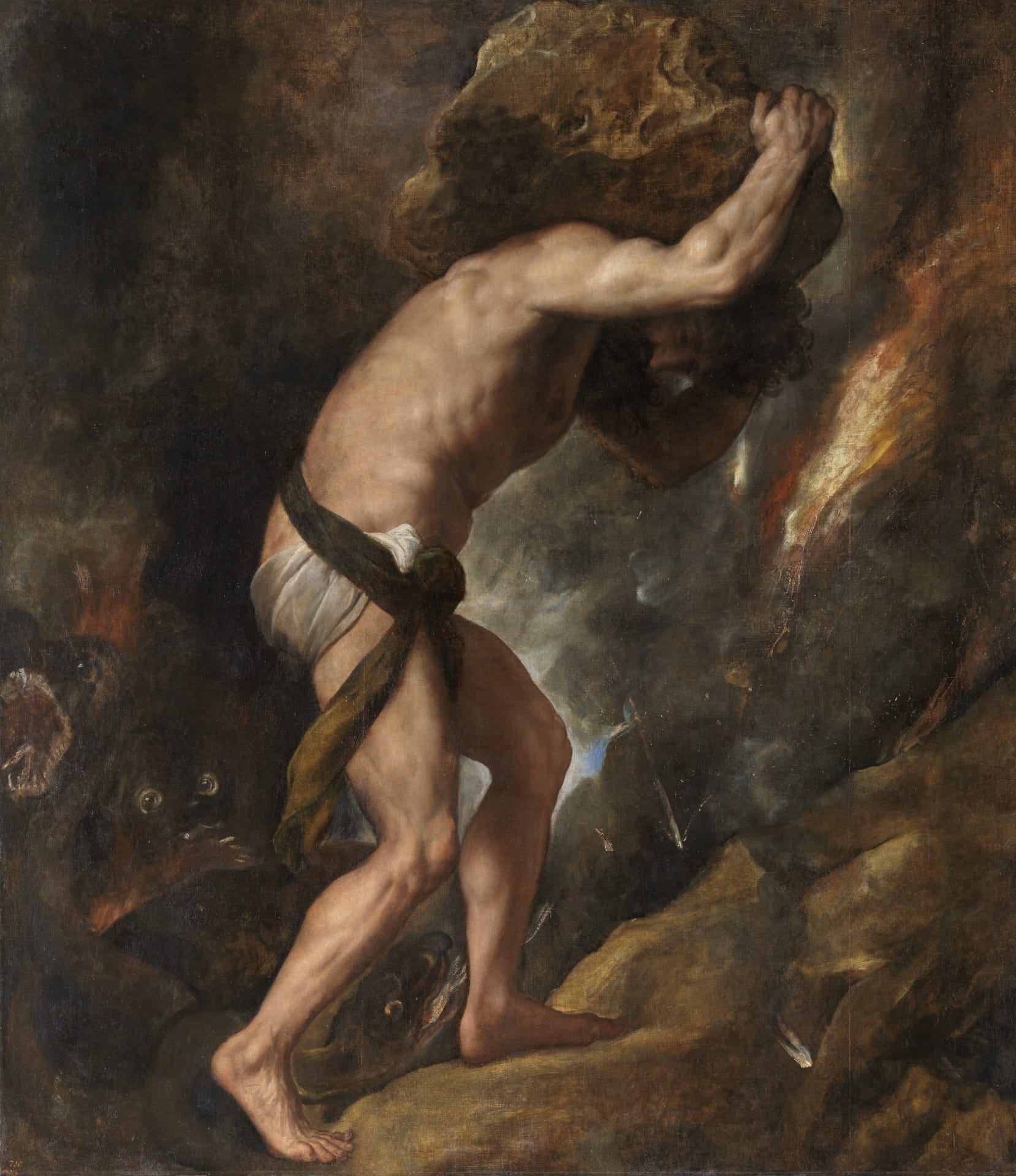
Camus said it through Sisyphus. A man pushing a rock up a mountain to watch it roll back down, forever. In Dostoevsky it’s the opposite. His characters only get saved when they accept suffering and connect with another human being. Kafka is the nightmare of not even being allowed to do that. Systems you don’t understand, where you can’t fight for anything. And Houellebecq reached the end of the road. What’s left when the struggle is gone.
They were all pointing at the same thing. But in my early twenties, all I saw was the void. I couldn’t see the mountain hidden inside it. Camus was the most explicit, but his frame never fully convinced me. Absurdism, accepting that nothing has meaning and living in rebellion against that, sounds good in an essay. At three in the morning on one of those sleepless nights, it doesn’t hold you up. I needed something more concrete.
The answer I didn’t expect
I found it last year in the most unlikely place. A terrorist’s manifesto. A book Alberto recommended to me, by the way. The same Alberto who laughed at my depressing books.
Ted Kaczynski, also known as the Unabomber, wrote Industrial Society and Its Future in 1995. I’m not going to defend what he did. He mailed bombs for 17 years, killed three people, and injured 23 others. But his diagnosis of society is, maybe, the most lucid I’ve ever read.
Kaczynski described what he called the “power process.” Human beings need to struggle for real goals. Not abstract ones. Real ones. The kind your life depends on.
For hundreds of thousands of years, life was direct. You’re hungry, you go hunt. If you hunt, you eat. If you don’t hunt, you don’t eat. No middleman, no abstraction. Effort and reward connected by a single thread. Your survival. You build a shelter, you sleep dry. You defend your people, they survive. Every action has real, immediate consequences you can see and touch.
And that effort, that daily fight that was hard and sometimes dangerous, filled you up. Not because it was pleasant, but because the reward was in the hunting itself. In the act of hunting, not the outcome. The effort of finding food for your family was, in itself, what gave the day meaning.
Today. You open an app and in ten minutes there’s hot food at your door. You turn the heating on with a button. You buy clothes without getting off the couch. You don’t need to hunt, build, or protect anyone. Technology has solved survival. And with it, it has erased the original source of meaning.
What happens when you don’t have to fight for the basics anymore? You invent substitutes. Kaczynski called them “surrogate activities.” Corporate careers, hobbies, piling up money far beyond any real need, likes on social media. They never fully satisfy. The one piling up money always wants more. The one climbing the corporate ladder never gets there. That insatiability is the signal. If the activity actually filled you up, there would be a point where you stopped. But it never comes, because the goal was artificial from the start. Your life didn’t depend on it.
I read that and felt like someone had finally put words to what I’d been feeling for years. It wasn’t that I was missing anything material. It was that I had too much comfort and not enough mountain. Camus had been right about the mountain, but Kaczynski explained why we need it and what happens when it gets taken away.
But Kaczynski diagnosed in the abstract. He told you what was happening, not how or where. I was missing the mechanism running in the real world, inside the current system.
The YouTube professor
And then, a few months ago, I found Jiang Xueqin. The latest person who has spoken to me directly, the way Kaczynski spoke to me, the way the “depressing books” spoke to me before that. Every once in a while, someone shows up who puts words to what you feel but can’t name. Jiang is the most recent one.
Jiang grew up poor in Toronto, the son of a cook and a seamstress. He studied literature at Yale, worked as a journalist in China, and now teaches philosophy at a high school in Beijing. He started recording his classes for his students and uploading them to YouTube. History, geopolitics, how the systems that govern us actually work. Today he has more than a million subscribers.
His analysis of consumerism is what hooked me. In the eighties, under Reagan and Thatcher, society shifted from being centered on the worker to being centered on the consumer. The government stopped promising you a good job and started promising you low prices and product variety. A subtle change with enormous consequences. You compete for prestige, you take on debt, you individualize, you lose solidarity. You develop an “economic logic.” You see everything through capital. Why are you studying? To get a good job. Why? To make money. Why? To buy things and post them on social media.
And here’s the part that got me. Consumerism is, in his words, “the perfection of slavery.” If you’re a slave, you rebel. But if you don’t know you’re a slave, and you actually like your cage, if you choose your own slavery, you never rebel. The perfect system. Brave New World without the science fiction.
Kaczynski’s surrogate activities (climbing the corporate ladder, piling up money, piling up followers) are the mechanism Jiang describes. Kaczynski diagnosed the void. Jiang showed me the machine that produces it.
And Camus had been right from the start. He just didn’t have proof. Kaczynski supplied it from theory, Jiang from the data.
Loneliness as a symptom
And then there’s the thing nobody wants to look at. We’re alone.
Not alone like “I don’t have plans on Saturday.” Actually alone. Structurally alone. We live in the most connected society in history and the loneliest one. More depression, more anxiety, more mental health crises than ever, even though technology gives us more than ever.
For Jiang, this is the direct consequence. Consumerism atomizes. It turns you into an individual, tears you out of community, sets you to compete against everyone. Solidarity disappears because it’s inefficient. Relationships become transactional. And in the end you’re left alone with your screen, scrolling reels at two in the morning, buying things you don’t need, optimizing your LinkedIn profile, while something rots inside you.
And his laboratory is East Asia. Japan, South Korea, China, Taiwan. The societies that industrialized fastest are the ones showing the symptoms first. Aging, structural loneliness, birth rates in free fall. But the extreme case is South Korea. Consumerism, capitalism, and individualism taken to the limit. And the result is right there in the data. A fertility rate of 0.75, the lowest in the world. You need 2.1 for generational replacement. Best case scenario, South Korea will be gone by 2150. Kurzgesagt made a whole video about it.
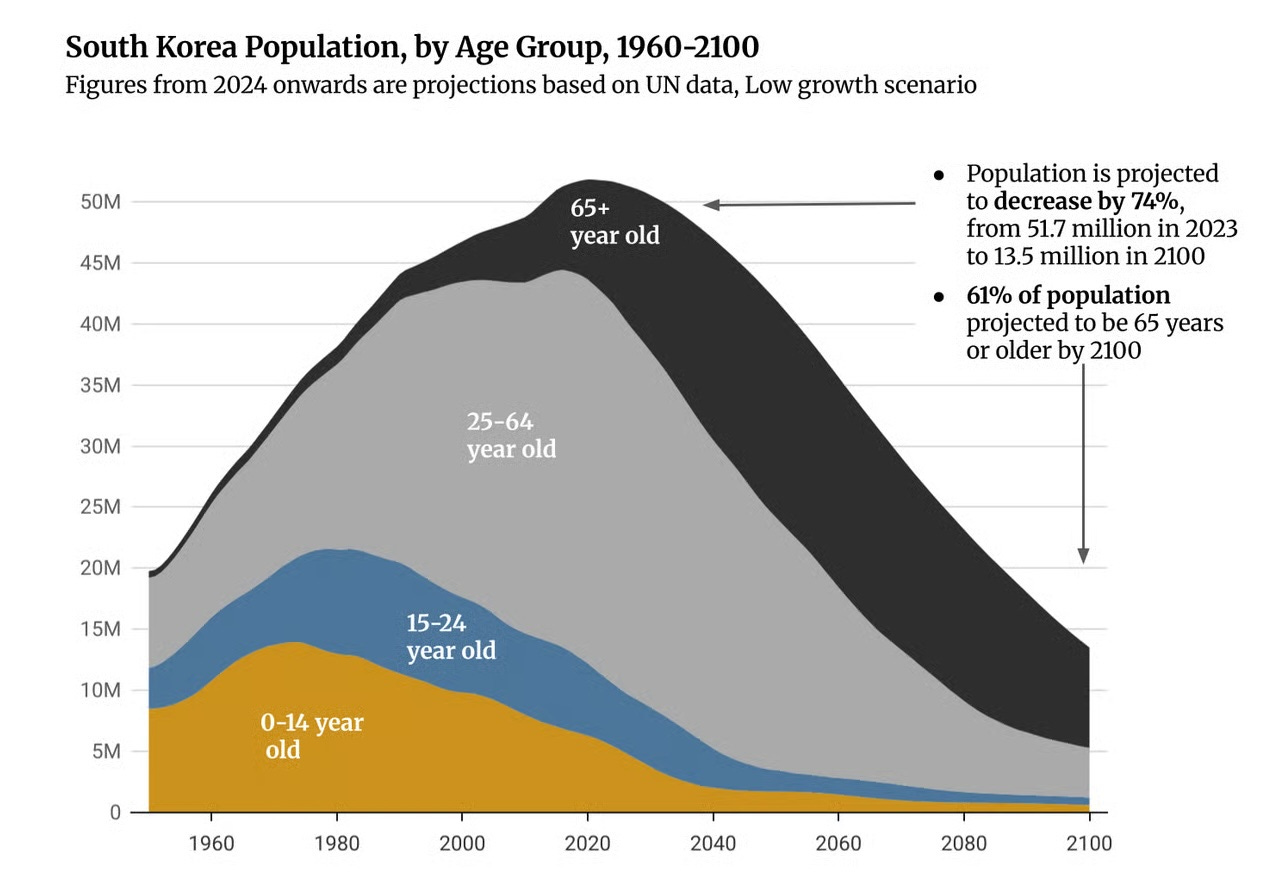
An entire society falling apart. One that has optimized so hard for the individual (status, money, comfort) that even reproduction has stopped making sense. It’s Jiang’s economic logic taken to the extreme. It’s Brave New World in real data.
And here’s what makes it urgent. The United States, Europe, all of the West, we’re 20 to 30 years behind Korea on that curve. The only thing keeping us afloat demographically is immigration.
Spike Jonze saw it before the data did. Her is this story. Theodore lives in a comfortable future, designed for individual convenience. He’s surrounded by technology. He has a job, a nice apartment, a beautiful city. And he’s deeply alone. So alone he falls in love with an artificial intelligence. Not because it’s an amazing machine, but because he doesn’t know how to connect with real people anymore.
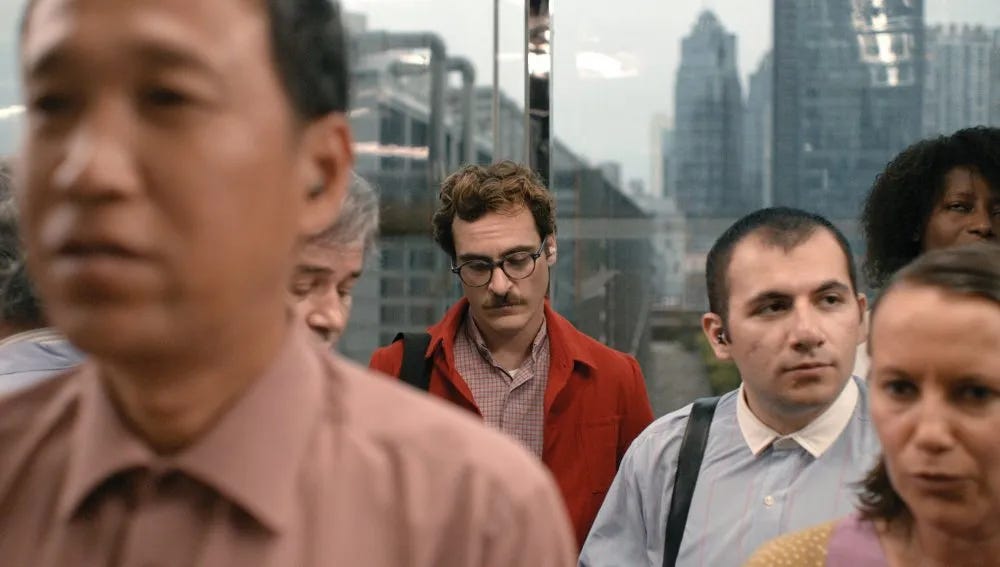
But AI doesn’t seduce us because it’s intelligent. It seduces us because we’re alone. Samantha doesn’t win Theodore over with her processing power. She wins him over because she listens, she understands, she accepts him without conditions. Everything a real human could give him, but that requires vulnerability, effort, the risk of rejection. AI gives you the connection without the cost. And the cost was what made it real.
The people who talk to ChatGPT like it’s a therapist. The teenagers who share more intimacy with a chatbot than with their friends. Not to mention porn, already a substitute, and now AI generates whatever you want. Everyone who prefers the comfort of an AI that always says the right thing over the friction of a human who sometimes doesn’t. They’re all Theodore. They choose the substitute because the original costs too much.
AI doesn’t solve loneliness. It perfects it. It gives you a substitute so good you stop looking for the real thing.
The survivor
And thinking about all this, another name came to me. Someone who had reached the same conclusion from the opposite side. Viktor Frankl, psychiatrist and Auschwitz survivor, wrote it in Man’s Search for Meaning. The prisoners who survived weren’t the strongest. They were the ones with a purpose. A book to write, a child to find again. “He who has a why to live can bear almost any how.”
Frankl writes that in the camps there was one moment that separated those who survived from those who didn’t. When a prisoner stopped looking toward the future. He stopped asking “when do I get out of here?” and started asking “what for?” The ones who lost the what for died within days. Not from hunger or illness. From emptiness. In the place with the least comfort in the world, the lack of purpose killed faster than the lack of food.
But Frankl went beyond purpose. He wrote something Kaczynski could have written. Human beings don’t need a state without tension. They need to struggle for a goal worth the effort, a task they chose freely. And the other side, the part nobody quotes: anyone who has every comfort in the world but no real struggle, sinks. I had read this years ago. I didn’t really understand it until now.
A concentration camp survivor. A terrorist. A YouTube professor. Three people with nothing in common, except the same answer:
Human beings need to struggle for something real. Meaning is in the struggle, in the mountain itself, not in the summit. Take away the mountain and something fundamental breaks.
Flattening the mountain
Every wave of technology has stripped away another layer of real effort. The industrial revolution took the physical. Consumerism filled the hole with surrogate activities. Social media atomized us. But AI is something else.
AI automates effort itself. Not the physical kind. The cognitive kind. Thinking, writing, solving, creating. What Frankl, Kaczynski, and Jiang say gives life its meaning. And it’s happening at a speed we can’t process. Our brains don’t understand exponential growth. The first steps are invisible and the last ones overwhelm you. If you want to see how far this goes, I lay it out with data in another article [to be published soon]. Will Smith eating spaghetti was a meme three years ago. Today AI-generated video is indistinguishable from reality. What looks exaggerated today will be obvious tomorrow.
Asking an AI to write you an article without ever having a single idea yourself. Generating an “artistic” image without ever touching a brush. Building an app without reading a line of code. The effort disappears, and with it, the meaning.
Huxley predicted this in 1932. Brave New World isn’t a world of surveillance and punishment like 1984. It’s a world of total comfort. The citizens take soma, a drug that erases any discomfort. You feel sad, you take soma. You feel anxious, you take soma. You never have to face anything. The State doesn’t need to repress because nobody wants to rebel. Why would they, if they’re happy? There’s infinite entertainment, sex without commitment, consumption without limits. John the Savage, the only character who comes from outside the system, asks for the right to suffer, to grow old, to fail. The Controller doesn’t understand why anyone would choose suffering.
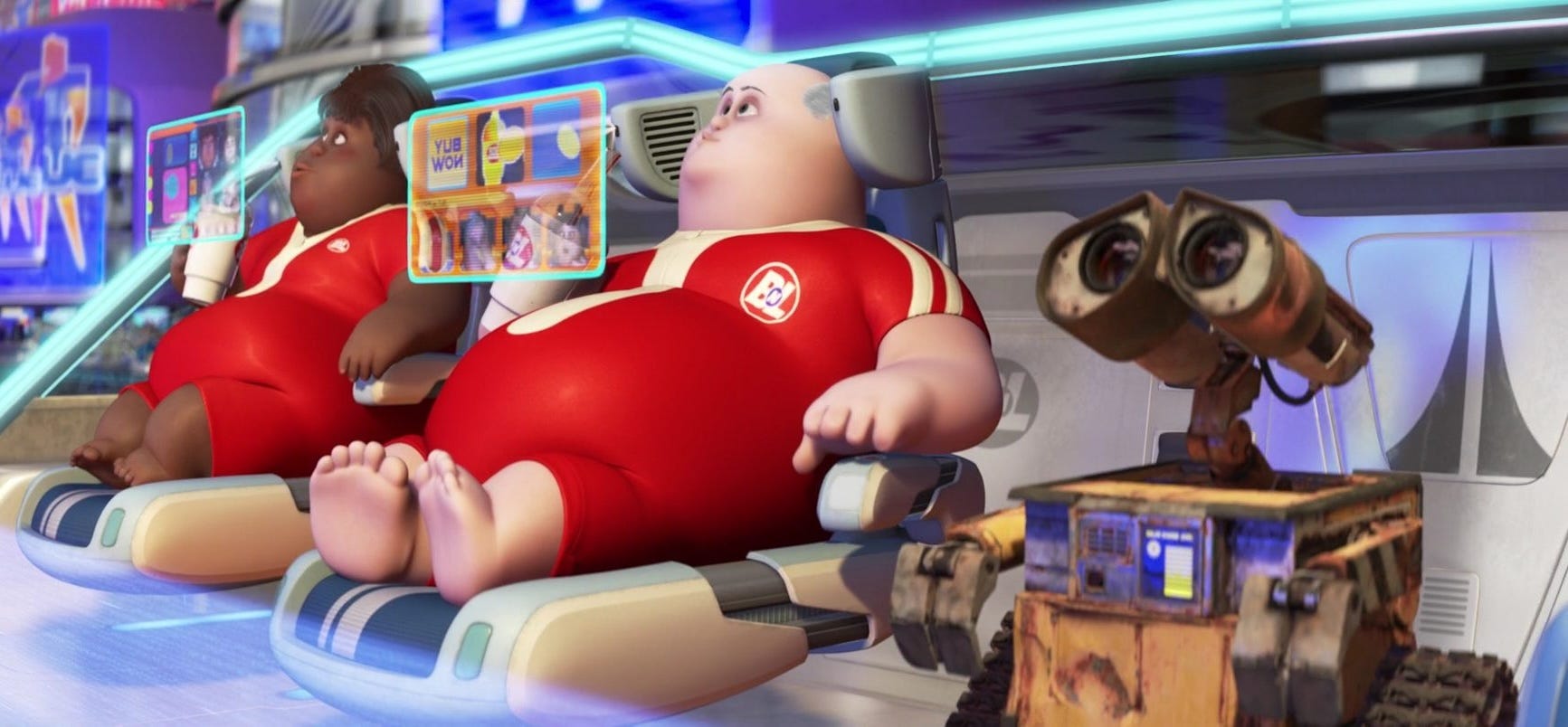
Pixar told the same story in 2008. In WALL-E, humanity lives on a spaceship where everything is automated. They’re obese, passive, glued to screens, unable to walk. A garbage robot has more curiosity and more life in him than any human on board. It was a kids’ movie, and it was supposed to be over the top. But look around. The average adult spends seven hours a day in front of a screen. Kids who can’t be bored without an iPad. Dinners where everyone is looking at their phone. People who scroll for two hours before bed and can’t remember anything they saw. We’re not on WALL-E’s ship, but we’re starting to look more and more like its passengers.
There’s no mountain in Brave New World. There’s no mountain in WALL-E. And AI is taking us there.
The contradictions
I’m an AI engineer. I’ve spent a decade building what I’m criticizing. I get paid to make the technology more capable, more autonomous, more “useful.” And I’m good at it.
I always thought I didn’t fall into the consumerist game. I don’t care about cars or material things. I don’t even have a personal Instagram. But I did fall into the status game Jiang describes. Personal branding. Subscribers. Talks. The Head of AI title. It’s another version of the same mechanism. Competing for prestige instead of for possessions.
I have a Her tattoo on my arm. My entire personal brand revolves around the movie that predicts what I build. And I’m writing this article with the help of Claude Code, an AI that lives in my notes and connects my ideas. An article about why AI is a problem.
And for years I was completely passive on politics and society. Too busy playing the status game to think about it. But if the solutions to everything I’m describing are political, then my passivity is another form of complicity.
What can’t be automated
And yet.
There are moments when none of what I’ve written matters. A dinner with friends where nobody is looking at their phone. Training until you can’t push anymore. The sea. Sitting on a park bench just to feel the sun on your face. Loving someone. Being loved. The cinema, two hours in the dark letting a story go right through you. Reading something that’s not going to make you more productive. A three-hour conversation that goes nowhere and shifts something in you.
Theodore chose Samantha because she was easier. But easy doesn’t fill you up. None of this produces anything, none of it scales, none of it can be optimized. It only exists if you’re there. Vulnerable, present, no filter.
Sisyphus pushes the rock knowing it’s going to fall. He pushes it anyway. “Il faut imaginer Sisyphe heureux.” We must imagine Sisyphus happy. Not because the rock stops falling. But because the meaning is in the act of pushing it.
I know Kaczynski might be right.
I know my mountain might be artificial.
I know the rock will fall again.
But I keep pushing it.
I buy your central thesis: effort gives meaning. The connection you draw between Kaczynski’s “power process,” Frankl, and Jiang works, and the idea that meaning lives in pushing the rock rather than reaching the top connects with a very old intuition. But I think there are other sources of meaning in human life that will survive AI, and your post leaves them a bit outside the frame.
Your frame reduces meaning almost entirely to struggle and productive effort. And I think human history offers other paths that don’t fit there.
1. The contemplative life. The Carthusian monks, the Poor Clares, the desert hermits. Their life isn’t a fight for survival in the Kaczynskian sense, and yet they report fullness. Meaning there comes from the relationship with the transcendent, not from instrumental effort.
2. The Greek philosophers. Aristotle placed theoria, contemplation, above the active life. For Epicurus, meaning was in friendship and ataraxia. The Stoics looked for inner virtue, not an external mountain.
3. Family. Raising a child takes effort, sure, but the meaning doesn’t really come from “struggling.” It comes from the bond, from loving and being loved. You sense this yourself at the end when you talk about “loving someone, being loved” as what can’t be automated.
4. Art and beauty received. Looking at the sea, listening to Bach. There’s no rock to push there.
5. And then there’s politics, which for me is the piece I miss the most. Aristotle, the same one who puts contemplation at the top, also defines man as zoon politikon, a political animal. Organizing ourselves together to decide how to live is constitutive of being human. Even if AI solves material survival, we’re still going to need to deliberate. About justice, about how to distribute what gets produced, about what kind of society we want. That doesn’t go away, it becomes more urgent. I think there’s a huge source of meaning right there, precisely when survival no longer gives it to us.
Frankl himself, who you cite, talked about three paths to meaning. The creative one (what we give to the world, your axis), the experiential one (love, beauty), and the attitudinal one (how we face unavoidable suffering). Your post stays almost entirely with the first, and I think widening it would do it good.
You acknowledge your political passivity as complicity, and I find it really honest of you to say it. I’d just add that, if the problems you describe are structural, the way out is maybe less about finding individual mountains to push, and more about the collective. The closing image of Sisyphus pushing his rock alone is beautiful, but also a bit lonely.
I think there are less lonely, more hopeful ways out.